


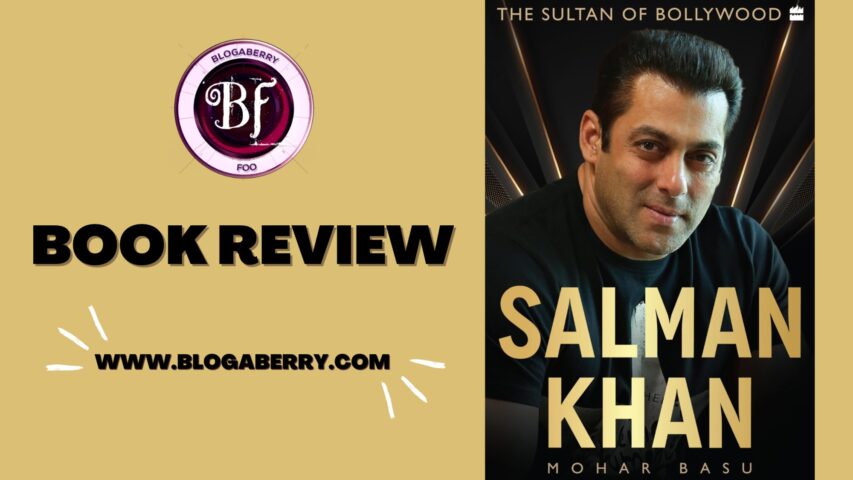
The cover has Salman Khan on it, duh, with a subtle smile on his face.
Name: The Sultan Of Bollywood (Salman Khan)
Author: Mohar Basu
Format: Hardcopy
Number of pages: 302
Availability: Amazon (Buy hardcopy here)
Rating: 4/5
The title was apt as the book was about the famous Sultan of Bollywood, a.k.a. the one and only Salman Khan.
The author has used simple but well-written Indian English. The word for today is swagger.
The biography of Salman Khan tells us about his life and how his transformation simply shows in the way he walks. As the author says, ‘Salman Khan’s walk morphed from boyish and casual to intense, bull-like’. The book talks about how he is loved by all ages, all religions and all types. How Salman defeats the notion that fame always changes people by living in his father’s house till today. According to Salman Khan, he’s not a superstar, but a normal, average Bandra boy. As we see in the award ceremonies, he never bothered about trophies. The book proves time and again how Salman Khan seems to work according to what his heart says: for his fans and for himself. He ignores the critics, the press and the accolades.
The book also mentions how Salman Khan outshone his hero, his father, Salim Khan, who once told him he was going to be a cult figure. Besides having a huge movie fan base, Salman Khan also had a whole bunch of people who looked up to him because he made fitness seem like fashion or casually a part of his everyday routine. He didn’t follow fads. His fitness was not based on his movies or shoots alone. This was who he was.
There were several things I loved about this book.
*I loved the rawness, the bluntness and the sixth sense.
*The author put into words what we all felt at some point in our lives: that we will meet someone like the green flag, Aman or Prem, in our lives. According to Google, Salman has played the sweet character ‘Prem’ in 15 Bollywood movies.
*The book showed us how Salman Khan brought all religions together just by being himself. His audience showed no discomfort, no hatred, just love for Salman Khan. For eg., in Bajrangi Bhaijaan, he was a Muslim, acting like a Hindu with Hindu tunes in the background while the movie was released around Eid.
* I agree with what was mentioned in the book: films are made primarily for entertainment; we can always take something away from it, but we shouldn’t expect it to teach us something every time. Films are not meant to be preachy.
*The book showed how Salim Khan was the type of father who never believed in praising his own son. I totally relate to his belief because instead of applauding my kids, I prefer it when other people realize and acknowledge my upbringing, appreciate my kids for who they are, what they do and how they behave, especially in public. Similarly, on a much larger scale, Salim Khan left Salman Khan’s fate to the public.
*It was interesting to know how Salman Khan’s fans were spread worldwide. For eg. an Iraqi fan somehow got his hands on a Salman Khan film and screened it for trusted Salman Khan fans in Iraq. He said that Salman Khan films meant a lot to him because they created another world where justice always prevailed and the good guy never lost. Real life wasn’t that simple, but for a few hours Salman Khan showed us it could be, in the cinema.
*I liked how the author found fans whose feelings for Salman Khan were deep. Their words said so much.
A few things were repetitive, but it didn’t matter. It’s a biography.
Reading about Salman Khan’s relationship with the media will allow one to understand why some celebrities treat media personnel so badly. Especially when some journalists think they have the right to make things up or blow things out of proportion just to attract readers. No one (famous or not) likes the public intruding into their personal lives. But sadly, yellow journalism is real. Even I, as an influencer and blogger, share only certain aspects of my personal life. What makes people from the media think that, for their TRP and personal benefits, they can intrude into other people’s privacy and personal lives? Just because they are famous? I believe that a celebrity’s work is to be made public, not their personal lives.
Also, I agree with Salman Khan’s perception of awards. Applying for an award is so cringe. And paying a fee for the application is even worse. I tried it once, but it felt like I was praising my own tail. I never did it again. I prefer when an award comes as a surprise. I prefer when someone else nominates me based on their research or findings. Maybe this does not happen in today’s world, but I’ll wait. Maybe someday someone will award me for the work I do. 😉
Salman Khan is my second-best actor. I don’t watch Bigg Boss and I didn’t like many of his recent movies. In fact, after watching his latest movie ‘Sikandar’, our family watched Bajrangi Bhaijaan all over again. Just to feel good. But I still read the book because I love the way Salman Khan is (as much as I know of course, never met him) and would love to meet him someday. And I would definitely recommend this book to someone who loves Salman Khan, too.
Maybe send this to a true Salman Khan fan and they will thank you for it. They may love reading all about him, even if they think they know his life history.
Do you know the difference between an autobiography, a biography and a memoir? Whose was your favourite? Tell us in the comments below.


